
Processing herbs
The process is pretty simple if you're not familiar. First you need grimy herbs, bought from the Grand Exchange or already sitting in your bank. At the scale required to be meaningfully profitable, purchasing is the only viable option.
You also need the Arceuus spellbook, an earth staff, and nature runes kept in your inventory or a rune pouch. If you don't have an altar of your own, the house party worlds always have someone hosting with an occult altar open. Degrime costs four earth and two nature runes per cast, and the staff supplies the earth runes, so natures are the only ones you ever pay for. One cast cleans every grimy herb in your inventory and takes 8 ticks, or 4.8 seconds.
The rune pouch takes an inventory slot, which is why a cast cleans 27 herbs rather than 28. In all, perfect processing takes 10 ticks per inventory:
- 8 ticks - Degrime cast
- 1 tick - deposit clean herbs
- 1 tick - withdraw grimy herbs

It's a really simple process, it just requires a lot of upfront capital to purchase enough herbs in bulk to be worthwhile. The trick to maximizing profit is to always be slow-buying the highest-margin herbs while also avoiding the low-volume ones. Buy low and sell high. The tool handles both of those. Knowing where a price is heading next comes from experience. (Just think how successful I could be if I dedicated this much time to actual trading.)
The tool
The dashboard is one table, a row per herb, sorted by hourly profit. It shows the buy price, both sell prices, the margin on each, the profit per hour, and how much of that herb has traded in the last hour. Anything under 2,000 an hour gets flagged, so a high margin on a herb nobody is trading doesn't trick me.
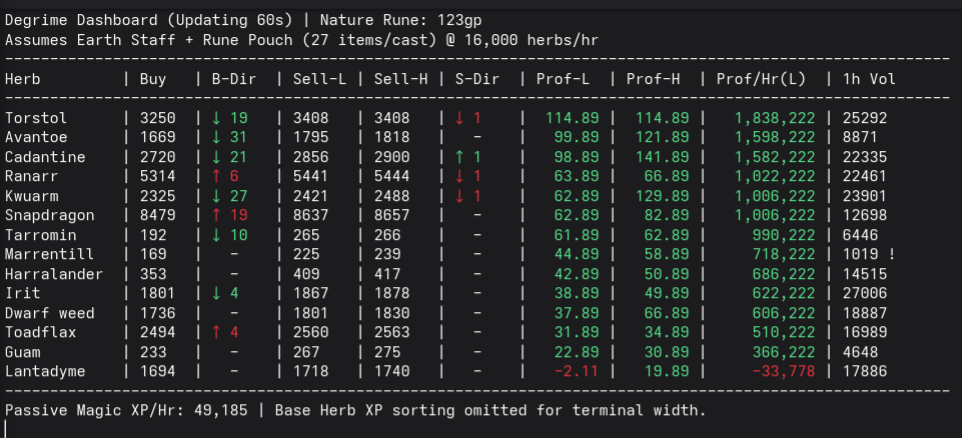
Beside the prices is a colored arrow and magnitude highlighting anything that just moved, and which way. Green is good and red is bad, which means the colors run opposite between the two columns: a rising buy price is working against me, a rising sell price is working for me.
While processing I keep the dashboard on one side of the monitor, automatically refreshing every minute. If something makes a big jump, I can put a buy order on whatever has just dropped in price, or dump volume before it crashes.
The calculation
The calculation is pretty simple. The API pulls in the latest buying and selling prices for each herb, and shows the margin between the two.
On the buy side the only price that matters is the low one, because I place offers and wait rather than buying instantly. On the sell side the high price is the one to aim for, but the tool calculates the profit at both prices and ranks on the low one, because that is what you actually get if you need to dump inventory in a hurry. A 100 gp gap between those two selling prices can be enough to make a herb too risky to bother with.
Since every herb cleans at the same rate, profit is based entirely on margin, runes (also pulled in by API), and taxes. As of writing this, I discovered the tool had the GE tax hardcoded at 1%, which has actually been 2% for a while. The error is 1% of the clean herb's price, so it grows with how expensive the herb is, which means all my Snapdragon processing was much less profitable than the tool was telling me. That will need to be corrected with any revisions.
The tool (just like the wiki) assumes a tick-perfect clean rate of 16,200 herbs an hour. Realistically, with error, time making buying and selling orders on the GE, and getting distracted watching YouTube, I manage 67-80% of that. I've debated whether to keep it at the perfect rate and do the math in my head, allow user input for a percentage of perfection, or find a way to track it within the game client and calculate actual profit. Ultimately though, the focus should be on optimal processing, buying, and selling rather than on calculating how much money you are making.
Tool in practice
Capital comes first, and you need quite a bit. What the tool does is make the capital you have worth more than it would be on many other processing tasks in the game, like logs or smelting. It also earned me quite a bit of Herblore experience, which I needed anyway. I went from around 60 to 80 over five to seven days, though I had started before the tool existed. The experience rate is the same either way. What the tool changed was the profit.
After building the tool, I spent three days running Degrime non-stop. I was fortunate enough to be able to borrow 100M gp from a friend to get started, but I think this would have been nearly as profitable with around 30-50M gp, and avoiding more expensive herbs like Snapdragon, since they eat all your working capital and you can miss better buying opportunities if you can't dump them at a good price.
I started off just doing whatever was the most profitable, with many herbs often sitting at around 2M gp/hr, but given my rate was only 67-80% of tick perfect, I started only buying when the profit was 3-5M gp/hr (actual rate of 2-4M gp/hr). Over the course of the three days I had earned 60M gp, was able to give the small 100M loan back to my friend, with interest, and bought myself the Osmumten's fang I had been dreaming of. Don't calculate how many hours that took me each day.
Buying and selling
Purchasing and selling strategically is very important to maximize profits, which is what the tool really helps with and could still be improved on. Basically I would place buy orders 1 gp above whatever the most recent sale was, to out-bid anyone else trying to do something similar. As people quick-sell, I get all of the herbs. Sometimes if it felt like I was fighting someone, I'd let them get their order fulfilled at a slightly higher price intentionally, thinking they may only be buying 1,000 for potions and nowhere near the four-hour buy limit, which runs somewhere between 11,000 and 13,000 depending on the herb. Sometimes this worked and other times it didn't.
Overnight I'd place large buy orders 100-200 gp below the current low buying price. They were often filled by morning, and that discounted herb pile was worth an extra 1-2M gp across the hour or so it took to clean through it.
Two things would make it better, and both carry the same problem. Tracking how much volume actually fills at a given price would tell me whether raising my bid is worth it instead of guessing. A plugin could take it further and set buy and sell prices on the GE almost automatically, the same way flipping tools do. But the second I make this that accessible, the margins go with it, and it turns into a bidding war with diminishing returns. If you're lucky enough to stumble across this, go and see what the current rates are.
I'm almost at a point skill-wise where mid-game bossing is brainless, so that will be more profitable soon anyway.